
Discover our latest updates.
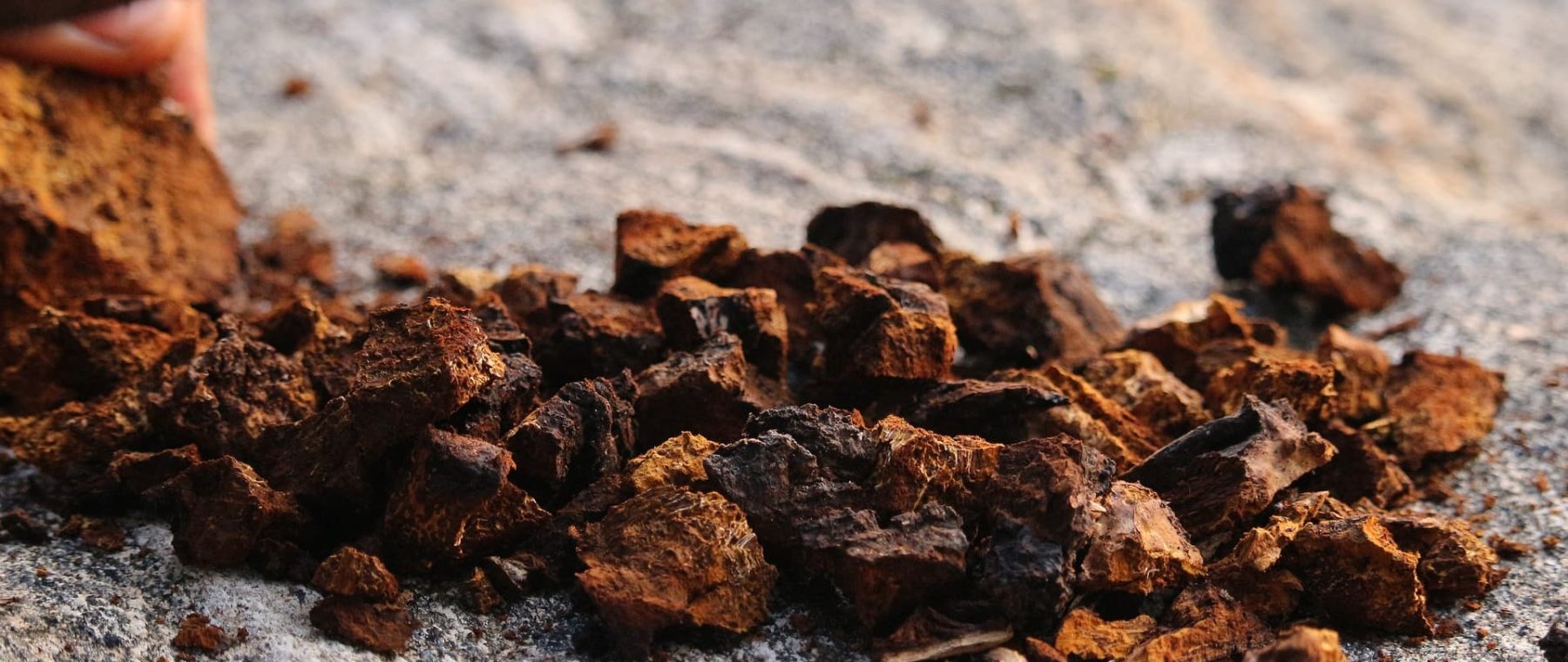
Inonotus obliquus – Chaga Mushroom
Chaga, Inonotus obliquus, is a fungus belonging to the Hymenochaetaceae family; it is a parasite of birch trees and grows in the forests of the cold regions of the Northern Hemisphere, particularly in northeastern Europe, Siberian Russia, Korea, Canada, and the islands of Okkaido. In ethnomedicine, the variety from Russia and Eastern European countries is generally used. It has been used as an ancient folk remedy to treat degenerative diseases, ulcers, gastritis, and tuberculosis.
Chaga has become “popular” in Western countries thanks to Nobel Prize winner Alexander Solzhenitsyn’s autobiography, *Cancer Ward* (published in Italy by Einaudi in 1968). In this book, he recounts his recovery from cancer thanks to a Chaga decoction, after conventional treatments had failed. Like many mushrooms, Chaga is rich in sterols (lanosterol, betulin, lupeol, inotidiol, etc.), antioxidants (SOD—superoxide dismutase, melanin), and polysaccharides (chitin, alpha- and beta-glucans). Chaga has the highest SOD content of any nutrient discovered to date—up to fifty times more than other medicinal mushrooms.
CHAGA AND CANCER: Chaga’s rich array of active compounds includes molecules belonging to the classes of terpenes/terpenoids, peptides, sterols, polyphenols, and polysaccharides, all of which are potentially active against cancer cells. For this reason, over the past ten years, Chaga and its extracts have been subjected to in vitro testing to evaluate their possible effects on cancer. The triterpenoid inotodiol, for example, has been shown to inhibit carcinogenesis and to exert an antiproliferative effect by inducing apoptosis. The polysaccharides found in Chaga have also demonstrated potential antitumor effects, both through their antioxidant action and their immunostimulatory effect.
ANTIOXIDANT AND ANTI-INFLAMMATORY EFFECTS: As mentioned earlier, Chaga contains polysaccharides with antioxidant properties, but it is above all a rich source of SOD (superoxide dismutase), an enzyme with powerful antioxidant properties that is essential for maintaining proper cellular redox balance, as it facilitates the elimination of the superoxide anion (produced by the body in small quantities under physiological conditions and in greater amounts during pathological states), which, in the presence of transition metals, can be converted into highly toxic free radicals. The simultaneous presence of polyphenols and polysaccharides complements and enhances Chaga’s antioxidant capabilities. Chaga extracts have also demonstrated anti-inflammatory effects in numerous tests, both in vitro and in vivo.
IMMUNOMODULATORY ACTION: Various studies have shown that Chaga’s endopolysaccharides are capable of modulating and stimulating the immune system;Chaga extracts can, for example, promote the activation of macrophages, thereby enhancing the immune response.
CHAGA AND THE BRAIN:The antioxidant and anti-inflammatory effects of Chaga extracts may also play a protective role against the onset and progression of neurodegenerative diseases such as Parkinson’s disease.
ANTIVIRAL ACTION: In addition to their immunostimulatory action, aqueous extracts of Chaga have demonstrated antiviral effects by inhibiting the mechanisms by which viruses penetrate cells.
CHAGA AND THE SKIN: Chaga and its extracts are also used as active ingredients in cosmetics and cosmeceuticals. Its antioxidant action may be helpful in preventing oxidative damage caused by UV rays. In vivo experiments conducted on rats have demonstrated Chaga’s ability toreduce skin thickening and the appearance of UV-inducedwrinkles, as well as to increase collagen synthesis, thereby helping toslow the skin aging process.
CHAGA AND METABOLISM: Several studies have investigated the potential effects of Chaga on metabolism. In particular, its potential effects on diabetes have been studied. Chaga extracts have been shown toreduce hyperglycemia and pancreatic damage in diabetic mice, raising hopes for its use in diabetes prevention.